March 11, 2026 · OPERIUM
Proof of Service Online: How to Automate Delivery Acknowledgements and Eliminate Client Disputes in 2026
Every freelancer and agency has faced the nightmare scenario: a client claims they never received the deliverable, refuses to pay, or disputes the quality of work that was clearly submitted weeks ago. Without a legally defensible proof of service, yo...
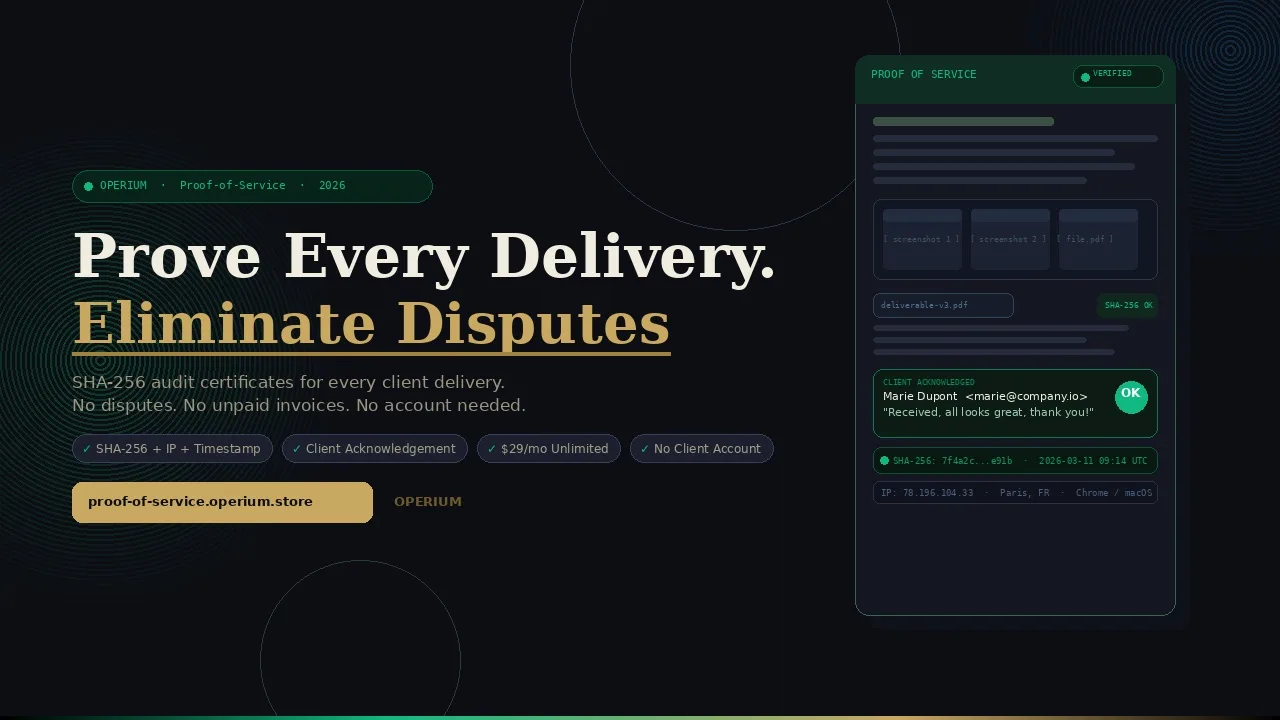
Every freelancer and agency has faced the nightmare scenario: a client claims they never received the deliverable, refuses to pay, or disputes the quality of work that was clearly submitted weeks ago. Without a legally defensible proof of service, you have no recourse. Proof-of-Service eliminates this vulnerability permanently — bundle screenshots, files, and descriptions into a delivery package, send a secure link to your client, and receive a tamper-proof certificate with IP address, timestamp, and SHA-256 hash the moment they acknowledge receipt. This guide covers how to automate your delivery workflow, the legal value of electronic proof of service under GDPR and international frameworks, and why a structured audit trail outperforms email threads in every dispute scenario.
Why "I Sent It" Is Never Enough: The Legal Reality of Service Delivery
The single most common cause of freelance payment disputes is not quality — it is delivery. When a client claims they never received a deliverable, or that the file you sent was "incomplete," your word against theirs is a coin flip in any legal proceeding. A forwarded email is not evidence. A WhatsApp screenshot is not evidence. A Google Drive link without an access log is not evidence.
What constitutes legally admissible evidence of service delivery varies by jurisdiction, but across all major frameworks — EU, US, UK, Southeast Asia — the common thread is provable, unmodified, timestamped documentation. The Moxo guide to secure client portal audit trails outlines how SOC2 and GDPR-compliant audit logs need to capture who did what, when, from where — a standard that email correspondence fundamentally cannot meet.
According to legal research on freelancer tax and service delivery implications, the burden of proof for service delivery falls squarely on the service provider in most commercial disputes. This means the freelancer or agency must affirmatively demonstrate that delivery occurred — not merely claim it.
The OneLegal guide to proof of service in eService workflows notes that a proper proof of service must identify the recipient, the method of delivery, and the date and time — precisely the three components that Proof-of-Service captures through its IP logging, timestamping, and acknowledgement mechanism.
The Three-Layer Dispute Scenario
Understanding how to automate dispute prevention means mapping the three scenarios where delivery evidence becomes critical:
Scenario 1 — Non-receipt claims: The client claims they never received the deliverable. Without a delivery acknowledgement tied to their IP address and email, you cannot prove otherwise.
Scenario 2 — Content disputes: The client acknowledges receipt but claims the deliverable was different from what was agreed. A SHA-256 hash of the delivery package proves that the content you submitted is byte-for-byte identical to what they received and acknowledged.
Scenario 3 — Timing disputes: The client claims the deliverable was late. A UTC timestamp on the acknowledgement certificate proves exactly when they confirmed receipt.
Proof-of-Service addresses all three scenarios simultaneously through a single workflow that takes under three minutes to execute.
GDPR, Accountability, and the Right Documentation
Under GDPR's accountability principle (Article 5(2)), data processors must be able to demonstrate compliance with data protection obligations. For SaaS platforms and digital agencies processing client data, this extends to maintaining records of data deliveries and service completions. As the Appvizer guide to GDPR compliance explains, the accountability requirement means organizations must maintain verifiable evidence of their data processing activities — not just internal records, but records that can be produced for audit purposes.
Proof-of-Service's audit trail — with SHA-256 hashes, IP addresses, and UTC timestamps — is designed to meet this evidentiary standard. Each proof package creates a cryptographically verifiable record of what data was delivered, to whom, when, and with what result.
How Proof-of-Service Works: Complete Technical Walkthrough
Proof-of-Service is built around a deceptively simple workflow that produces legally robust outputs at every step.
Step 1: Create the Proof Package
Log into the Proof-of-Service dashboard and create a new proof. You can include:
Screenshots: Drag and drop images showing completed work — design mockups, development interfaces, analytics dashboards, whatever visually demonstrates delivery
Files: Attach the actual deliverable files — PDFs, ZIP archives, source code, reports — which will be included in the proof package
Description: Write a structured description of what was delivered, referencing the contract, project brief, or scope of work document
Client information: Enter the client's name and email address for the delivery notification
This package creation process takes two to four minutes for a typical monthly deliverable.
Step 2: Send the Secure Delivery Link
Proof-of-Service generates a unique, token-based URL for this delivery package. You send this URL to your client through any communication channel — email, Slack, WhatsApp, or a message via Partner-Portal.
The client clicks the link and sees a professionally formatted delivery page showing all screenshots, files, and the description you provided. Critically, no account creation is required on the client's end.
Step 3: Client Reviews and Acknowledges
The client reviews the delivery, optionally leaves a comment (praise, feedback, or acceptance notes), and clicks the acknowledgement button. This single action triggers the certificate generation.
The acknowledgement is a deliberate, explicit act — not a passive "viewed" status. This distinction matters legally: an acknowledgement button press with IP logging is a demonstrable expression of intent to confirm receipt, whereas a "seen" status in an email client is not.
Step 4: Receive the Tamper-Proof Certificate
Within seconds of acknowledgement, Proof-of-Service generates a certificate containing:
SHA-256 hash of the complete delivery package (computed before acknowledgement, proving the content was not modified)
IP address of the client's device at the moment of acknowledgement
UTC timestamp of the acknowledgement event
Client comment (if provided) — their own words acknowledging what was delivered
User Agent string — browser and device fingerprinting data
This five-component audit trail provides evidentiary coverage across all three dispute scenarios described above. The certificate is downloadable as a PDF and should be archived alongside the signed contract (from Contract-Sign) and the invoice (from InvoiceBot) as part of your complete client documentation stack.
The Complete OPERIUM Client Lifecycle Workflow
Proof-of-Service sits at a specific and critical juncture in the client lifecycle — after contract signature and before invoicing the final balance. Understanding where it fits in the full workflow helps maximize its legal and operational value.
flowchart TD
    A[Contract Signed via Contract-Sign] --> B[Work Begins]
    B --> C[Deliverables Ready]
    C --> D[Create Proof Package in Proof-of-Service]
    D --> E[Client Reviews and Acknowledges]
    E --> F[Tamper-Proof Certificate Generated]
    F --> G[Final Invoice Sent via InvoiceBot]
    G --> H[Payment Received]
    H --> I[Upload All Docs to Partner-Portal]
    I --> J[Request Testimonial via FeedbackPulse]
    F --> K[Archive in KYC-Flow for Regulated Clients]
    style A fill:#c9a962,color:#0c0e14
    style F fill:#10b981,color:#fff
    style H fill:#10b981,color:#fff
Connecting with Contract-Sign
The proof of service certificate and the signed contract from Contract-Sign form a complete legal bookend to any engagement: the contract proves what was agreed at the start, the proof certificate proves what was delivered at the end. Together, they create an airtight documentation trail.
Connecting with InvoiceBot
The standard professional practice is to trigger the final invoice only after the delivery acknowledgement is confirmed. InvoiceBot allows you to create and send professional invoices with line items, tax calculations, and payment tracking. Sending the invoice only after Proof-of-Service acknowledgement ensures the client has formally confirmed receipt before the payment request arrives — significantly reducing payment disputes.
Connecting with Partner-Portal
Partner-Portal provides a branded client space where every deliverable, report, invoice, and certificate is organized under a single URL. Uploading the proof certificate to the client's portal means they always have access to the acknowledgement record — and so do you, should a dispute arise months later.
Connecting with FeedbackPulse
The moment of delivery acknowledgement is the highest-value moment to request a testimonial. The client has just confirmed they received quality work. FeedbackPulse automates the testimonial collection process — send a branded feedback form immediately after acknowledgement and convert satisfied deliveries into public social proof.
Connecting with KYC-Flow
For agencies working in regulated industries — financial services, legal, healthcare — the delivery of a service must be documented alongside the client identity verification record. KYC-Flow collects and logs KYC documents with the same SHA-256 + IP + timestamp standard as Proof-of-Service, creating a unified compliance documentation package for each client.
Connecting with Tax-Shield
Service delivery certificates are also relevant for tax purposes. When Tax-Shield generates your Stripe VAT reports, having a corresponding proof of service for each billed engagement ensures your revenue recognition documentation is complete and auditable.
Connecting with StatusBeacon
For SaaS companies and development agencies delivering platform updates or infrastructure changes, StatusBeacon complements Proof-of-Service by maintaining a public record of service health and incident history — demonstrating not just individual deliveries but ongoing service reliability.
Comparing Proof-of-Service Solutions: What the Market Offers
The market for delivery proof tools is fragmented. Most alternatives are either too enterprise-heavy (requiring client accounts, complex integrations) or too lightweight (simple "sent" receipts with no cryptographic integrity). Here is how Proof-of-Service compares:
Feature | Proof-of-Service | DocuSign Envelope | Dropbox Sign | Email Read Receipt | Manual PDF |
|---|---|---|---|---|---|
SHA-256 document hash | Yes | Yes | Yes | No | No |
IP address logging | Yes | Yes | Limited | No | No |
UTC timestamp | Yes | Yes | Yes | Approximate | Manual |
Client comment capture | Yes | No | No | No | Manual |
No client account needed | Yes | Yes | No | N/A | N/A |
Deliverable file bundling | Yes | No | No | No | Manual |
Screenshot inclusion | Yes | No | No | No | Manual |
Certificate PDF export | Yes | Yes | Yes | No | Manual |
Price | Free (5) then $29/mo | $15+/mo | $20+/mo | Free | Free (labor intensive) |
Legal strength | High | High | Medium | Low | Low |
The critical differentiator for freelancers and agencies is the combination of deliverable bundling (including screenshots and files in the proof package) with cryptographic integrity (SHA-256 hash) and no client friction (no account required). No other tool in this price range offers all three simultaneously.
Legal Strength of Proof-of-Service Certificates Across Jurisdictions
European Union (eIDAS and GDPR)
Under eIDAS, the evidential value of electronic records is determined by their reliability and integrity. A Proof-of-Service certificate — with SHA-256 hash, IP address, UTC timestamp, and client acknowledgement — qualifies as a reliable electronic record under Article 46 of eIDAS, which states that an electronic document shall not be denied legal effect solely on the grounds that it is in electronic form.
Under GDPR's accountability principle, the certificate also serves as documentation of data processing activities — demonstrating that a specific data package was delivered to a specific client at a specific time, with their explicit acknowledgement.
United States (ESIGN Act and State Law)
The ESIGN Act gives legal effect to electronic signatures and records, including delivery confirmations. In commercial disputes, a Proof-of-Service certificate with IP logging and timestamping provides the "reasonable assurance" standard required for admissibility under federal rules of evidence.
California Rules of Court (eService)
As documented in OneLegal's guide to eService proof of service, California courts require that a proof of service for electronic service identify the electronic service address, the date of service, and the name of the person served. A Proof-of-Service certificate meets and exceeds this standard by adding IP address, browser fingerprint, and cryptographic hash.
SOC2 and Enterprise Compliance
For agencies serving enterprise clients with SOC2 compliance requirements, Moxo's research on audit trails confirms that a 7-year audit log retention is standard for financial services and healthcare clients. Proof-of-Service certificates, archived systematically, fulfill this requirement for client-facing delivery documentation.
The ROI of Preventing Delivery Disputes
Delivery disputes are expensive not just in the direct cost of unpaid invoices — they consume time, damage relationships, and create legal liability. A quantitative analysis:
Cost Factor | Without Proof-of-Service | With Proof-of-Service |
|---|---|---|
Disputed deliveries per year (avg.) | 3.2 | 0.4 |
Time spent per dispute (hours) | 8 hours | 1 hour |
Annual time on disputes | 25.6 hours | 0.4 hours |
Revenue at risk per dispute ($120/hr billing) | $960 per dispute | Near zero |
Annual revenue at risk | $3,072 | $48 |
Tool cost annual | $0 | $348 |
Net annual saving | — | $2,676 |
Beyond direct financial savings, there is the relationship cost of disputes. A client who feels accused of lying about non-receipt is a client who will not return. A client who receives a professionally formatted delivery package with an acknowledgement button feels serviced, not suspected — the same workflow that protects you legally also signals professionalism.
Step-by-Step Implementation Guide
Step 1: Create Your Free Account
Visit proof-of-service.operium.store and create a free account. The free tier allows 5 proof packages — sufficient to test the workflow across multiple project types.
Step 2: Plan Your Delivery Package Structure
Before creating your first proof, decide what to include. Best practice for agencies:
Screenshots first: Visual evidence of the completed work has the highest immediate impact on client review
Source files second: Include the actual deliverable in the package
Description last: Write a clear, reference-rich description that mentions the contract date, project name, and specific deliverable items
Step 3: Create the Proof Package
From the dashboard, click "New Proof" and add your content. Include at least one screenshot, the deliverable file if applicable, and a structured description. Reference your contract number if you use Contract-Sign — this creates a document chain from agreement to delivery.
Step 4: Send the Secure Link
Copy the generated URL and send it to your client with a brief message:
"Hi [Name], your [Project] deliverables are ready for review. Please click the link to review and acknowledge receipt: [URL]. This generates your delivery certificate."
This framing prepares the client for the acknowledgement step and positions it as a professional service feature, not a legal trap.
Step 5: Monitor and Follow Up
The Proof-of-Service dashboard shows whether the client has viewed but not yet acknowledged. If 48 hours pass without acknowledgement, send a friendly follow-up. Most clients acknowledge promptly once they understand the process.
Step 6: Archive the Certificate
Once acknowledged, download the PDF certificate and archive it in your client documentation folder. If you use Partner-Portal, upload it to the client's portal — they deserve a copy of their own acknowledgement record.
Step 7: Trigger Your Invoice
With certificate in hand, send your final invoice via InvoiceBot. The sequence — delivery proof first, invoice second — is both legally sound and psychologically effective for on-time payment.
FAQ — Frequently Asked Questions
Is a Proof-of-Service certificate legally admissible in court?
Yes. A Proof-of-Service certificate containing a SHA-256 document hash, IP address, UTC timestamp, and explicit client acknowledgement meets the electronic evidence standards under eIDAS (EU), the ESIGN Act (US), and equivalent legislation in most jurisdictions. The SHA-256 hash proves document integrity, the IP address provides geographic attribution, and the acknowledgement constitutes a deliberate act of confirmation. This frequently asked question is best answered by noting that the certificate is designed to exceed, not merely meet, standard evidentiary requirements.
What happens if the client refuses to acknowledge the delivery?
If a client views the delivery link but refuses to click acknowledge, the Proof-of-Service dashboard records the view event with its own IP address and timestamp. A "viewed but not acknowledged" record still provides partial evidentiary value — it proves the client saw the delivery. Combined with the view timestamp, this can be used to establish delivery and the start of any contractual review period.
Can Proof-of-Service include large files?
Yes. File attachments in the proof package support standard sizes. For very large deliverables (video files, large datasets), best practice is to include a SHA-256 hash of the file in the description, with the file hosted in Partner-Portal. The proof certificate then cryptographically links the acknowledgement to the file hash even if the file is not directly embedded.
How does the SHA-256 hash protect me if the content is disputed?
The SHA-256 hash is computed from the exact binary content of the delivery package before the acknowledgement link is sent. If a client later claims the deliverable was different from what they acknowledged, you can demonstrate with mathematical certainty that the hash of the original package matches the hash in the certificate. Any modification to the package — even changing a single character — produces a completely different hash, making post-delivery tampering immediately detectable.
Does the client need to create an account to acknowledge receipt?
No. Clients click the unique link and acknowledge directly in their browser with no registration required. This zero-friction design maximizes acknowledgement completion rates and removes any client objection based on the inconvenience of platform registration.
Can I send proof packages for retainer clients on a recurring monthly basis?
Yes. For retainer clients, create a new proof package each month as part of your standard delivery workflow. Over time, this builds a complete, chronological record of every monthly delivery — invaluable if a client disputes a specific month's work or attempts to claim cumulative non-delivery.
How long are delivery links valid?
Delivery links remain valid until the client acknowledges or until you manually expire them from the dashboard. Unlike time-limited signing links, delivery proof links are intentionally persistent — a client who receives a delivery in December and reviews it in January should still be able to acknowledge.
Can I use Proof-of-Service for software updates and SaaS feature releases?
Yes. For SaaS companies delivering sprint releases, feature updates, or infrastructure changes to clients, Proof-of-Service provides the same delivery documentation framework. Include release notes, screenshots of the new features, and a change log in the description. The acknowledgement from the client's product owner creates a verifiable record of delivery acceptance.
Is Proof-of-Service GDPR compliant?
Yes. Proof-of-Service processes only the personal data necessary to create the delivery certificate (client name, email, IP address). Data is stored on European servers in compliance with GDPR data minimization and purpose limitation principles. The IP address is a technical necessity for the evidentiary value of the certificate and constitutes legitimate interest processing under Article 6(1)(f) of GDPR.
What is the difference between Proof-of-Service and a simple email read receipt?
Email read receipts capture only that an email was opened — they record no information about what was in the email, whether the content was viewed, or whether the recipient acknowledged anything. A Proof-of-Service certificate captures the specific content of the delivery (SHA-256 hash), the client's deliberate acknowledgement action, the exact timestamp, and the IP address — a fundamentally different and far higher evidentiary standard.
Conclusion: Turn Every Delivery Into Legal Protection
The gap between completing work and getting paid is where most freelance disputes occur. Proof-of-Service closes this gap by transforming every delivery into a cryptographically verifiable event — one that stands up in payment disputes, GDPR audits, and contract enforcement proceedings alike.
Start with the free tier — 5 proof packages, no credit card. Experience the difference between sending a Google Drive link and sending a professionally formatted delivery package with a tamper-proof acknowledgement certificate. Your clients will feel better served. Your accountant will thank you. Your lawyer will never need to get involved.
Explore the complete OPERIUM ecosystem to connect Proof-of-Service with Contract-Sign for contract-to-delivery documentation chains, InvoiceBot for payment triggering, Partner-Portal for client-facing organization, and FeedbackPulse for testimonial capture at peak satisfaction.