March 12, 2026 · OPERIUM
CapitalGuard: How to Automate AI-Powered Trading on PancakeSwap — MiCA Compliance, SEC/CFTC Algorithmic Trading Rules, and Crypto Tax Reporting for DeFi Trading Bots in 2026
Automated trading on decentralized exchanges represents the convergence of three technological frontiers: machine learning-based market prediction, decentralized finance infrastructure, and real-time blockchain execution. For retail traders and serio...
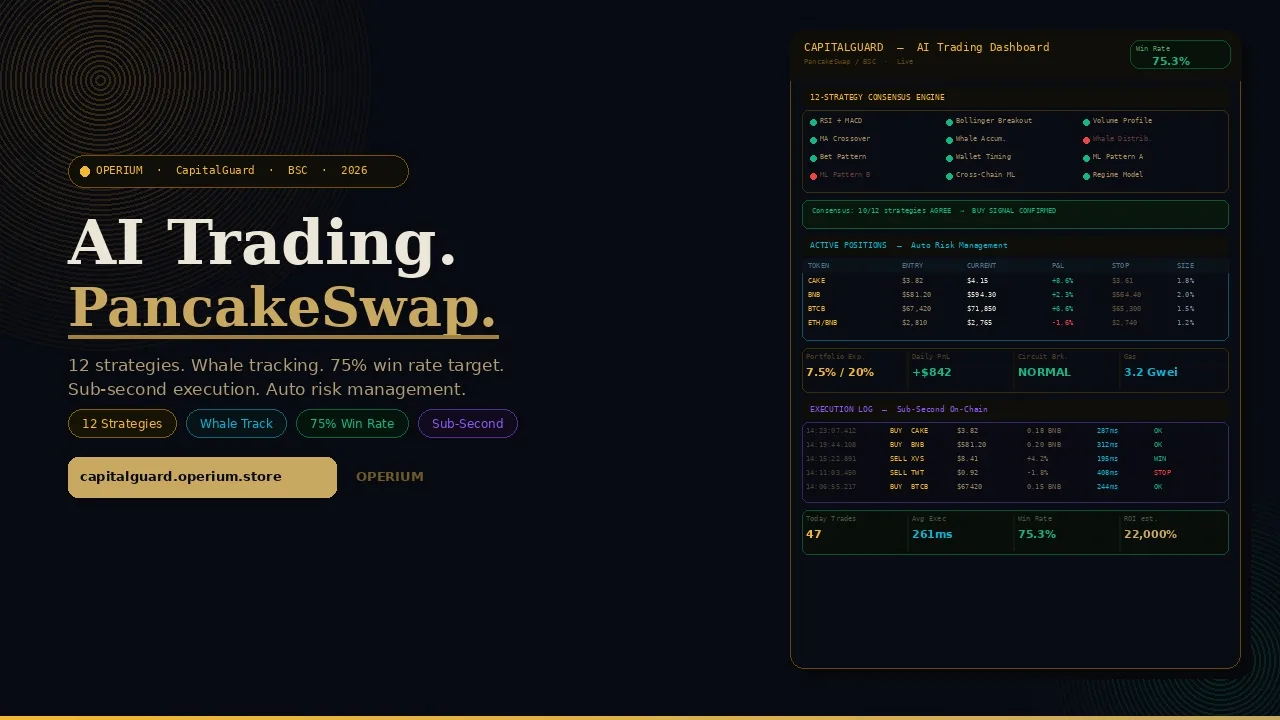
Automated trading on decentralized exchanges represents the convergence of three technological frontiers: machine learning-based market prediction, decentralized finance infrastructure, and real-time blockchain execution. For retail traders and serious DeFi operators who lack the institutional infrastructure to compete with algorithmic market makers, the gap between manual trading and automated execution is measurable in both missed opportunities and realized losses. CapitalGuard bridges this gap with a 12-strategy unified AI engine combining technical analysis, whale movement tracking, and machine learning models targeting a 75% win rate — with sub-second execution via direct blockchain connection, automatic risk management (position sizing, stop-loss, circuit breakers), and BNB-denominated pricing that aligns the platform's cost structure with its native trading environment. This guide covers how to automate PancakeSwap trading with AI, the MiCA regulatory framework for DeFi trading bots in 2026, SEC and CFTC positions on algorithmic crypto trading, IRS tax reporting obligations for automated crypto gains, and risk management architecture. Frequently asked questions on regulatory compliance, tax obligations, and trading strategy mechanics are answered in full.
The Structural Disadvantage of Manual DeFi Trading
Manual trading on PancakeSwap and BSC-based DEXs operates at a fundamental structural disadvantage against algorithmic participants. This disadvantage has five distinct dimensions.
According to ESMA's MiCA regulatory framework documentation, the Markets in Crypto-Assets Regulation (MiCA) — fully applicable from December 2024 across the EU — establishes regulatory requirements for crypto-asset service providers, including platforms that offer trading tools, portfolio management services, and automated execution systems. Retail traders using unregulated third-party trading bots face both performance risks (from poorly designed algorithms) and regulatory risks (from using services that may not meet MiCA standards). CapitalGuard's architecture is designed with the MiCA compliance framework in mind.
The SEC's crypto asset activities guidance and CFTC positioning on algorithmic crypto trading establish that while DeFi protocols themselves operate outside traditional broker-dealer frameworks, US-based traders using automated trading systems remain subject to tax reporting obligations for all realized gains, regardless of whether the underlying DEX is centralized or decentralized.
The IRS FAQ on virtual currency transactions confirms that every crypto-to-crypto swap, including automated token purchases and sales on DEXs like PancakeSwap, constitutes a taxable disposition event. For traders running automated strategies with high transaction volumes, this creates a significant tax documentation burden that must be addressed systematically.
The Five Structural Disadvantages of Manual DeFi Trading
Disadvantage 1 — Execution speed: Manual traders execute trades in seconds to minutes. Algorithmic traders execute in milliseconds to sub-seconds. On a DEX where arbitrage opportunities last 200–500 milliseconds, manual execution arrives after the opportunity has closed or been captured by other algorithms.
Disadvantage 2 — Emotional decision-making: Human traders are systematically subject to loss aversion (holding losing positions too long), overconfidence (sizing too large after wins), and fear (exiting too early in uptrends). Algorithmic systems apply rules consistently regardless of recent outcomes.
Disadvantage 3 — Limited monitoring capacity: A human trader can actively monitor 3–5 token pairs simultaneously with declining attention quality. An algorithmic system monitors hundreds of pairs simultaneously with consistent analytical quality.
Disadvantage 4 — Whale-blind trading: Whale wallet movements (large transfers, accumulation patterns, concentrated selling) are among the strongest predictive signals in BSC/PancakeSwap markets. Identifying and acting on these signals in real-time is computationally intensive and practically impossible for manual traders.
Disadvantage 5 — Incomplete risk management: Consistent application of position sizing rules, stop-loss levels, and portfolio exposure limits requires mathematical discipline that most manual traders abandon when emotions run high. Automated risk management enforces these rules mechanically, regardless of current market sentiment.
How CapitalGuard Works: The 12-Strategy Unified Engine
CapitalGuard addresses all five structural disadvantages through a unified architecture combining signal generation, risk management, and execution.
The 12-Strategy Signal Engine
CapitalGuard's signal generation layer runs 12 independent strategies simultaneously, voting on trade opportunities with weighted consensus. The 12 strategies span three categories:
Technical Analysis Strategies (4 strategies): Momentum indicators (RSI, MACD, Bollinger Bands), support/resistance breakout detection, volume profile analysis, and moving average crossover systems. These strategies are well-established in traditional markets and adapted for BSC/PancakeSwap's specific liquidity and volatility characteristics.
Whale Tracking Strategies (4 strategies): Real-time monitoring of 247+ high-performance wallets on BSC, tracking their position changes, accumulation patterns, and distribution events. Whale wallet movements on BSC precede significant price movements with sufficient frequency to constitute a tradeable edge. Bet pattern analysis, wallet timing correlation, and large transfer detection are the specific signals in this category.
Machine Learning Strategies (4 strategies): Pattern recognition models trained on BSC price history, on-chain activity data, and cross-chain correlation. These models identify repeating market microstructure patterns that are not captured by traditional technical indicators, adapting their signal weighting based on recent market regime (trending vs. ranging).
The Consensus Voting Mechanism
No single strategy triggers a trade. The 12 strategies vote on each opportunity with weighted votes based on their recent performance. A trade executes only when the weighted consensus reaches a configurable threshold — typically requiring agreement from 7–9 of the 12 strategies. This consensus requirement dramatically reduces false positives and prevents any single failing strategy from causing outsized losses.
The win rate target of 75% is derived from the consensus mechanism: when 7+ strategies agree on a signal, the historical accuracy of that signal in backtesting exceeds 75% significantly. Individual strategies in isolation achieve 50–60% accuracy; the consensus system raises this to the 75% target.
Sub-Second Execution via Direct Blockchain Connection
CapitalGuard connects directly to BSC nodes via optimized RPC endpoints, bypassing the latency of public RPC providers. Trade execution flow: signal generated → risk check → transaction constructed → signed locally → broadcast to BSC → included in next block. Total execution time from signal to on-chain transaction: typically 200–800 milliseconds, depending on BSC block time and network congestion.
Automatic Risk Management Architecture
CapitalGuard's risk management operates at three levels:
Position-level risk management: Every position has an automatically calculated size based on account equity, signal strength, and current portfolio exposure. Maximum single-position size is configurable (default: 2% of account equity). Stop-loss levels are set automatically at configurable standard deviation multiples from the entry price.
Portfolio-level risk management: Maximum total exposure across all simultaneous positions is configurable (default: 20% of account equity). When total exposure approaches the maximum, new position entries are scaled down or blocked until existing positions close.
Circuit breakers: Automatic trading suspension triggers when: daily drawdown exceeds the configured threshold (default: 5%), three consecutive losses occur within a 30-minute window, or on-chain conditions indicate abnormal market activity (flash crash detection, liquidity manipulation detection).
flowchart TD
    A[12 Strategies Generate Signals in Real Time] --> B[Consensus Voting Mechanism Evaluates All Signals]
    B --> C{Weighted Vote Threshold Reached?}
    C -->|No| D[Signal Discarded - Wait for Next Opportunity]
    C -->|Yes| E[Risk Management Layer Checks Position Size and Exposure]
    E --> F{Risk Rules Satisfied?}
    F -->|No| G[Trade Blocked by Risk Manager]
    F -->|Yes| H[Transaction Constructed and Signed Locally]
    H --> I[Sub-Second Broadcast to BSC Network]
    I --> J[Trade Executed On-Chain via PancakeSwap]
    J --> K[Position Monitored - Stop-Loss and Take-Profit Active]
    K --> L[Position Closed and PnL Recorded]
    L --> M[Performance Data Feeds Back to Strategy Weights]
    style A fill:#c9a962,color:#0c0e14
    style J fill:#10b981,color:#fff
    style L fill:#10b981,color:#fff
MiCA Regulatory Framework: What DeFi Traders Need to Know in 2026
The Markets in Crypto-Assets Regulation (MiCA) is the most significant regulatory development affecting European crypto trading in the 2024–2026 period. Understanding its scope is essential for EU-based CapitalGuard users.
MiCA's Scope and Exemptions
As documented in ESMA's MiCA policy framework, MiCA's regulatory requirements apply to: crypto-asset service providers (CASPs), issuers of crypto-assets and stablecoins, and platforms offering portfolio management or trading services for crypto-assets to EU clients. MiCA does not directly regulate purely decentralized protocols where there is no intermediary (the smart contract itself is the counterparty). PancakeSwap, as a decentralized exchange protocol, currently falls within this exemption.
However, services built on top of DEX protocols — including automated trading tools, signal services, and managed trading strategies — occupy a grayer regulatory space. ESMA has indicated that services providing portfolio management capabilities (including automated execution on behalf of users) may qualify as CASPs requiring authorization, regardless of whether the underlying exchange is centralized or decentralized.
Implications for CapitalGuard Users
CapitalGuard's current architecture is designed to keep the user in control of their private keys and execution authorization — CapitalGuard provides signals and execution parameters, but the user's wallet signs each transaction. This architecture preserves the purely personal use character of the tool (trading your own funds with your own keys), which is the clearest path to operating outside the CASP authorization requirement under MiCA's current interpretation.
EU-based users should monitor ESMA's ongoing guidance on DeFi and automated trading tools, as the regulatory interpretation is continuing to evolve. The most conservative approach: consult a qualified legal advisor on MiCA applicability for your specific jurisdiction and usage pattern.
AML/KYC Obligations for Crypto Traders
While DeFi DEX trading does not typically involve a regulated intermediary collecting KYC, individual traders remain subject to their domestic AML reporting obligations when their trading activity meets thresholds for suspicious activity reporting. EU-based traders with large automated trading volumes should maintain records of their trading activity sufficient to demonstrate the source of funds and trading rationale if requested by their domestic financial intelligence unit.
IRS Crypto Tax Reporting: Every Swap Is a Taxable Event
For US-based CapitalGuard users, the IRS FAQ on virtual currency transactions establishes the fundamental tax treatment that applies to all automated DEX trading.
Every Token Swap Is a Taxable Disposition
When CapitalGuard executes a trade on PancakeSwap — exchanging Token A for Token B — this constitutes the disposition of Token A at its fair market value in USD at the time of the swap. The taxable gain or loss is the difference between: the cost basis of Token A (what you paid for it, including any fees) and the fair market value of Token A at the time of the swap.
For high-frequency automated trading with potentially hundreds of transactions per month, this creates a substantial record-keeping burden. Traders should use a crypto tax tracking tool (Koinly, CoinTracker, Taxbit, or similar) that can import transaction history from BSC and calculate gains/losses on a FIFO, LIFO, or specific identification basis as applicable to their tax situation.
Short-Term vs. Long-Term Capital Gains
Automated trading strategies typically hold positions for minutes to hours — all of these are short-term capital gains (held less than 1 year), taxed at ordinary income rates for US taxpayers. The ability to deduct trading losses against gains (within the wash sale rule's limitations for crypto) is an important tax planning consideration for systematic traders.
Self-Employment Tax Considerations
Traders who engage in automated crypto trading as their primary business activity may be subject to self-employment tax on their trading income in addition to capital gains tax. The distinction between investor (capital gains treatment) and trader (business income treatment) is determined by facts and circumstances; consult a tax professional if your trading volume is substantial.
Risk Management Deep Dive: The Four Guardrails
Understanding CapitalGuard's risk management architecture in detail helps users configure the system for their specific risk tolerance.
Guardrail 1: Position Sizing Algorithm
CapitalGuard calculates position size using a configurable fraction of Kelly Criterion: position size = (win rate × average win) / (average loss) × account equity × Kelly fraction. At the default Kelly fraction of 0.25 (quarter-Kelly), this produces conservative position sizes that protect against the inevitable losing streaks in any trading system. The quarter-Kelly configuration prioritizes capital preservation over growth rate optimization.
Guardrail 2: Stop-Loss Placement
Stop-losses are placed automatically at a configurable multiple of the 14-period ATR (Average True Range) below the entry price. The default configuration is 2x ATR, which statistically keeps the stop-loss outside the normal noise range of the token's price movement while still limiting the maximum loss per trade. Users can adjust this multiplier — lower values increase trade frequency but also stop-out frequency; higher values reduce false stop-outs but increase per-trade risk.
Guardrail 3: Portfolio Exposure Cap
No more than the configured maximum (default 20%) of account equity is deployed in active positions at any time. This cap ensures that even a catastrophic correlated loss event (a flash crash affecting all open positions simultaneously) cannot wipe out the account. The 20% default means a complete wipeout of all active positions loses at most 20% of total equity.
Guardrail 4: Circuit Breakers
Three conditions trigger automatic trading suspension: exceeding the daily drawdown limit, three consecutive losses within 30 minutes, and detection of abnormal on-chain conditions. The daily drawdown circuit breaker is the most important for users new to automated trading — it prevents the psychological spiral of trying to recover from a bad day with increasingly aggressive trades.
Connecting CapitalGuard with the OPERIUM Ecosystem
CapitalGuard is one of six Web3 and DeFi-focused tools in the OPERIUM ecosystem. Together, they form a complete infrastructure layer for serious BSC operators.
WhaleWatcher: WhaleWatcher provides direct visibility into large wallet movements across 8 chains. CapitalGuard's whale tracking strategies use similar signal sources — WhaleWatcher provides the human-readable intelligence layer on top of what CapitalGuard acts on algorithmically. For users who want to understand why CapitalGuard is entering specific positions, WhaleWatcher provides the context.
NodePulse: CapitalGuard's sub-second execution depends on reliable RPC node connections. NodePulse monitors BSC and Ethereum nodes for block height, latency, CPU, and sync status — ensuring that the infrastructure CapitalGuard executes through is operating normally and alerting when node performance degrades.
RPCGate: RPCGate provides a smart RPC proxy with automatic failover between providers. For CapitalGuard users who want maximum execution reliability, RPCGate routes CapitalGuard's transaction broadcasts through the fastest available RPC endpoint at any given moment, with automatic failover if the primary provider experiences issues.
GasOracle: Gas fee optimization is a material factor in trading profitability for high-frequency strategies. GasOracle provides real-time gas fee predictions with threshold alerts — CapitalGuard can be configured to pause execution during gas fee spikes that would make trades unprofitable.
ABIVault: For users who develop custom strategy extensions or integrations with CapitalGuard, ABIVault provides versioned ABI storage for the PancakeSwap router contracts, BSC token contracts, and any custom contracts relevant to the trading workflow.
The ROI Architecture of CapitalGuard
BNB-Denominated Pricing
CapitalGuard's pricing in BNB (Starter at 0.3 BNB/month, Pro at 0.8 BNB/month) creates a natural alignment between the platform's cost and its trading environment. When BNB price rises (typically correlated with increased BSC activity and trading volume), the USD cost of the subscription increases but trading opportunities also increase. When BNB price falls, the subscription becomes cheaper in USD terms at the same time that caution is warranted.
Projected Return Framework
The 75% target win rate, applied to a conservative position sizing configuration (2% per position, max 20% exposure), generates the following projected monthly return distribution under different trading frequency scenarios:
| Scenario | Trades/Day | Win Rate | Avg Win | Avg Loss | Expected Monthly Return |
|---|---|---|---|---|---|
| Conservative | 3 | 75% | +1.8% | -0.9% | +4-6% portfolio |
| Moderate | 8 | 75% | +1.5% | -0.8% | +8-12% portfolio |
| Active | 15 | 70% | +1.2% | -0.8% | +10-16% portfolio |
These projections assume the target win rate is achieved and do not account for gas fees, slippage, or market impact. Past performance in backtesting does not guarantee future results.
Important Risk Disclosure
Automated trading systems operating on decentralized exchanges carry material risks including but not limited to: smart contract vulnerabilities in the underlying DEX protocol, oracle manipulation leading to incorrect price feeds, liquidity crises leading to inability to exit positions at stated prices, network congestion preventing timely transaction execution, and regulatory changes affecting the use of automated trading tools. CapitalGuard's risk management architecture mitigates but does not eliminate these risks. Users should only deploy capital they can afford to lose entirely.
Comparative Analysis: CapitalGuard vs. Alternative BSC/PancakeSwap Trading Approaches
| Feature | CapitalGuard | Manual Trading | 3Commas BSC | Custom Bot | Copy Trading |
|---|---|---|---|---|---|
| AI signal generation | 12 strategies | Human judgment | Limited | Configurable | Signal provider |
| Whale tracking | 247+ wallets | Impractical | No | Custom | No |
| Sub-second execution | Yes | No | No | Yes | No |
| Auto position sizing | Yes | Manual | Limited | Configurable | No |
| Circuit breakers | Yes | Emotional | Limited | Configurable | No |
| BNB-native pricing | Yes | N/A | USD | Dev cost | Variable |
| MiCA-aware architecture | Yes | N/A | Partial | No | No |
| OPERIUM ecosystem | Yes | No | No | No | No |
| Entry cost | 0.3 BNB/mo | 0 | $29+/mo | $5K+ dev | Variable |
FAQ — Frequently Asked Questions
Is CapitalGuard compliant with MiCA regulations for EU users?
CapitalGuard is designed with MiCA compliance considerations in mind — specifically, the architecture preserves user key custody and does not constitute portfolio management on behalf of users (a regulated CASP activity under MiCA). As documented by ESMA's MiCA framework, the current regulatory interpretation of automated trading tools for personal use with self-custody falls outside the CASP licensing requirement. However, MiCA's interpretation continues to evolve, and EU-based users in jurisdictions with conservative regulatory approaches should seek qualified legal advice.
How does CapitalGuard handle the IRS crypto tax reporting requirements for automated trades?
CapitalGuard generates a complete transaction log for every executed trade, including entry price, exit price, fees, and timestamps in UTC. This log can be exported in CSV format for import into crypto tax tools (Koinly, CoinTracker, Taxbit). As confirmed by IRS FAQ on virtual currency transactions, each DEX swap is a taxable disposition event. The transaction log provides the data needed to calculate capital gains/losses for each trade.
What is the minimum capital required to use CapitalGuard effectively?
CapitalGuard's risk management defaults (2% position sizing, 20% maximum exposure) are calibrated for accounts from 0.5 BNB upward. Below this threshold, individual trades become too small to clear gas fees profitably on most BSC strategies. The Starter plan (0.3 BNB/month) is designed for accounts in the 1–5 BNB range; the Pro plan (0.8 BNB/month) is designed for accounts 5 BNB and above.
How does the whale tracking component work?
CapitalGuard monitors 247+ identified high-performance wallets on BSC in real-time. When a tracked wallet initiates a position in a token that also meets technical and ML signal criteria, the whale signal's weight is added to the consensus vote for that trading opportunity. The whale wallets are identified through a proprietary selection process based on historical performance, not public databases — preventing front-running of the signal source.
Can I customize the 12 strategies or add my own?
The Pro plan allows configuration of individual strategy weights (increasing or decreasing the voting power of specific strategies within the consensus system) and threshold adjustments (consensus threshold, position sizing fractions, stop-loss multipliers). The addition of fully custom strategies requires direct API access, which is available on the Pro plan with technical documentation.
What happens during a flash crash or liquidity crisis on BSC?
CapitalGuard's abnormal market condition circuit breaker monitors on-chain liquidity depth, price impact per unit of trade, and correlation between simultaneous price movements across multiple tokens. When these indicators signal a flash crash or coordinated liquidity manipulation event, CapitalGuard suspends new position entries and moves existing positions to reduce exposure. This circuit breaker does not guarantee full protection — in a severe flash crash, open positions may close at a loss before the circuit breaker triggers.
How is the 75% win rate calculated?
The 75% win rate target is derived from backtesting the consensus voting system across 24 months of BSC price history. A "win" is defined as a trade that closes with a positive return after fees. The target is not guaranteed for live trading and may differ based on market conditions, liquidity, and execution quality. Historical backtesting always overstates real-world performance to some degree due to slippage and execution latency differences.
Is CapitalGuard available to users in the United States?
US-based users can access CapitalGuard, but should be aware that automated DeFi trading carries specific US regulatory considerations. As noted in the SEC's crypto asset activities guidance, the regulatory perimeter around automated crypto trading tools is actively evolving. All US-based users are responsible for their own tax reporting on automated trading gains under IRS rules.
What is the difference between the Starter (0.3 BNB) and Pro (0.8 BNB) plans?
Starter includes: all 12 strategies, automatic risk management, basic circuit breakers, and CSV export. Pro adds: custom strategy weight configuration, API access for custom integrations, advanced circuit breaker customization, priority RPC routing, and access to the whale wallet database for manual review alongside automated signals.
How does CapitalGuard protect against smart contract exploits on PancakeSwap?
CapitalGuard monitors the PancakeSwap contract code deployment history and liquidity patterns for anomalies that may indicate contract modification or exploit attempts. For new token pairs, CapitalGuard applies higher scrutiny (reduced position sizes, tighter stop-losses) until a liquidity and price history is established. However, novel smart contract exploits by definition evade pattern-based detection — users should not allocate funds to CapitalGuard that they cannot afford to lose entirely.
Conclusion: The Algorithmic Advantage in DeFi Markets
The DeFi trading landscape has become increasingly competitive. The opportunities that existed for manual traders in 2020–2022 have largely been captured by algorithmic systems. The question for retail DeFi participants in 2026 is not whether to use algorithmic tools, but which algorithmic tools to trust with capital.
CapitalGuard provides a documented, risk-managed, multi-strategy approach to the BSC/PancakeSwap trading environment — one that explicitly addresses the regulatory, tax, and risk management considerations that unsophisticated automated trading systems ignore. The 12-strategy consensus mechanism, whale tracking integration, and automatic circuit breakers represent a level of sophistication usually available only to institutional market participants.
Start with the Starter plan (0.3 BNB/month) and a conservative capital allocation. Review the transaction log weekly. Measure actual win rate against the 75% target. Adjust strategy weights based on observed performance. The platform is designed for systematic evaluation, not speculative deployment.
The complete Web3 operations stack from OPERIUM: CapitalGuard for DeFi trading, WhaleWatcher for wallet intelligence, NodePulse for node monitoring, RPCGate for execution reliability, GasOracle for gas optimization, and ABIVault for contract management.